Who will save Dhaka’s roads? (Part-II)
Who will save Dhaka’s roads when rainwater turns damaged streets into hidden traps for commuters? Across the capital, potholes disappear beneath stagnant

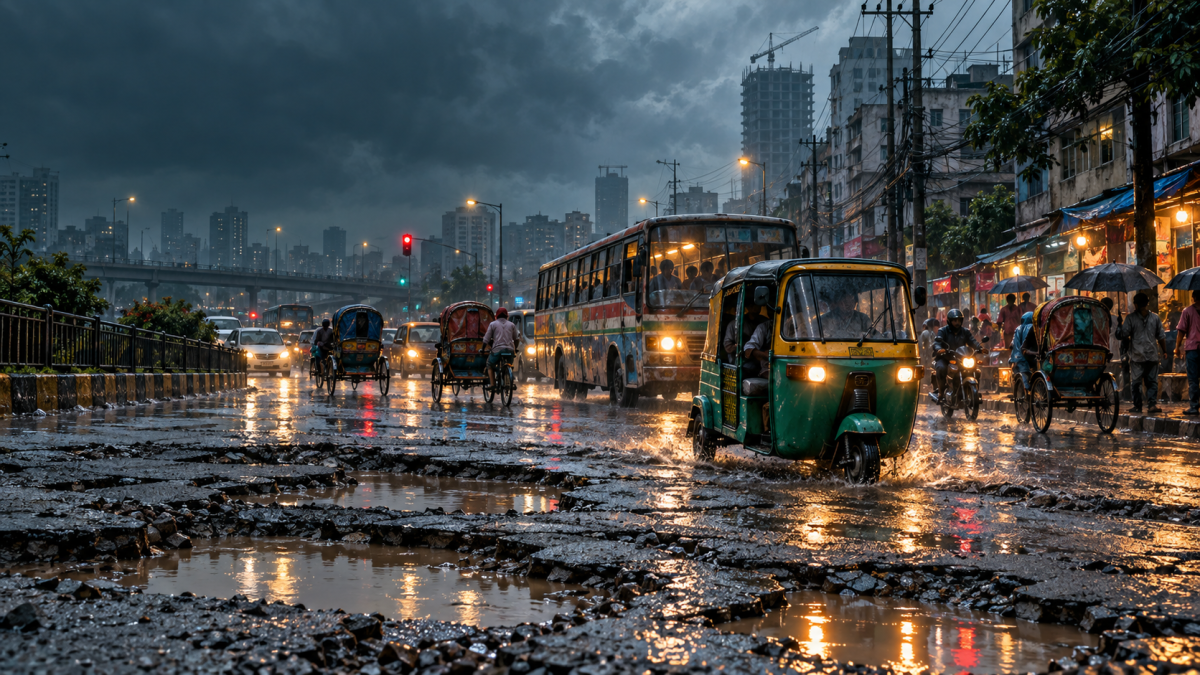
Table of Contents
Who Will Save Dhaka’s Roads?
Thebangladaily.com – Who will save Dhaka’s roads when rainwater turns damaged streets into hidden traps for commuters? Across the capital, potholes disappear beneath stagnant water, leaving rickshaws jolting, buses leaning and pedestrians exposed to danger. Large sums are spent on road development every year, but broken surfaces, unfinished excavation work and poor drainage continue to make daily travel difficult during the monsoon.
Residents contribute through taxes and VAT, yet many must navigate muddy lanes, open holes and waterlogged routes. After recent heavy rainfall, damaged roads were visible in Mirpur, Agargaon, Shyamoli, Mohammadpur, Rayerbazar, Farmgate, Gulshan, Banani, Mohakhali, Tejgaon, Badda, Shahjadpur, Nurerchala, Narda, Kuril, Khilkhet and the airport area. The condition of these roads raises a pressing question: who is responsible for restoring them properly and keeping them usable?
Extent of Repairs Needed in Dhaka North
Dhaka North City Corporation has a road network of around 1,560 kilometres. About 460 kilometres require repair or reconstruction this year, including 210 kilometres in the 36 older wards and 250 kilometres in the 18 newer wards. This means nearly 30 per cent of the network needs attention, showing the scale of the challenge facing the city corporation.
In the 2024-25 fiscal year, DNCC improved 61 kilometres of roads, 52 kilometres of drains and 16 kilometres of footpaths at a cost of about Tk 378 crore. Under a special programme, it also built or improved 39 kilometres of roads and 48 kilometres of drains, with expenditure of Tk 338 crore. Such work is important, but the persistent condition of many busy roads suggests that repair quality, coordination and maintenance require closer attention.
During 2025-26, the corporation improved 131.70 kilometres of roads, 136.9 kilometres of drains and 48 kilometres of footpaths for around Tk 314 crore. The special programme added approximately 102 kilometres of roads and 96 kilometres of drains. This year’s allocation is about Tk 568 crore, while the special programme has another Tk 570 crore available. The investment is substantial, yet residents still expect smoother roads and effective drainage throughout the city.
Busy Roads, Dangerous Potholes and Daily Delays
Important routes under DNCC include Mirpur Road, Kazi Nazrul Islam Avenue, Begum Rokeya Sarani, Shaheed Tajuddin Ahmad Sarani, Airport Road, the Dhaka-Mymensingh Highway, Bir Uttam Rafiqul Islam Avenue and Pragati Sarani. One particularly poor section lies on Pragati Sarani between Kuril and the Narda Bazar bus stand. The roughly one-kilometre stretch has become a serious concern for people travelling through the area.
Deep potholes force buses to tilt and drivers to make sudden turns to avoid damage. Those manoeuvres slow traffic and increase the risk of collisions. Asphalt has peeled away on Airport Road opposite Dhaka Regency and near the Khilkhet bus stand. Bad patches are also found from Dhanmondi Road 27 towards Mohammadpur bus stand and Bosila Teen Rasta, where commuters regularly face slow and uncomfortable journeys.
The problem extends well beyond major corridors. Many feeder roads in Badda remain in poor shape, while the Khilkhet Railgate-Dumni road is difficult for vehicles to use. The Mirpur 10-Kachukhet route is badly damaged, and the road from Uttara’s Jasimuddin Circle toward the airport continues to sink. Large potholes have also appeared on the embankment road between Aminbazar in Gabtoli and Babubazar.
Neighbourhood Roads Need Equal Attention
A 250-metre lane from Sadek Khan Road beside Rayerbazar’s Baishakhi playground to the community centre has potholes, standing water and exposed iron rods. Other badly affected locations include Post Office Road and Namapara in Khilkhet, Banshtola, Talni in Dumni, Kazibari Mosque Road in Kuril and Barobigha Road in Bhatara. At Barobigha Road, a large hole pushes vehicles toward the opposite lane. Cholmaid, West Nurerchala and Pallabi also need urgent repairs.
Who will save Dhaka’s roads is not simply a question of budget allocation. It is also about timely repair work, reliable drainage, proper supervision of utility excavation and accountability when contractors leave roads unsafe. Temporary patchwork may offer short-term relief, but roads used by thousands each day need durable resurfacing and regular inspection before rain makes the damage worse.
FAQ: Dhaka Road Conditions
Why do Dhaka roads deteriorate quickly during rain?
Water entering cracks and potholes weakens road surfaces. When drainage is inadequate and heavy vehicles continue to use damaged stretches, the road can deteriorate rapidly.
Which areas currently need major attention?
Reported problem areas include Pragati Sarani, Airport Road, parts of Badda, Khilkhet, Mirpur, Uttara, Rayerbazar, Bhatara, Nurerchala and Pallabi, along with several neighbourhood roads.
What would make road repairs more effective?
Long-lasting repairs require quality materials, drainage work completed alongside road work, prompt restoration after digging and consistent monitoring of contractors and agencies responsible for public infrastructure.