
Nepal flash flood: 1127 death recorded
The Bhotekoshi River, one of the most powerful waterways threading through Nepal's central hills, unleashed a wall of water and debris last Wednesday morning

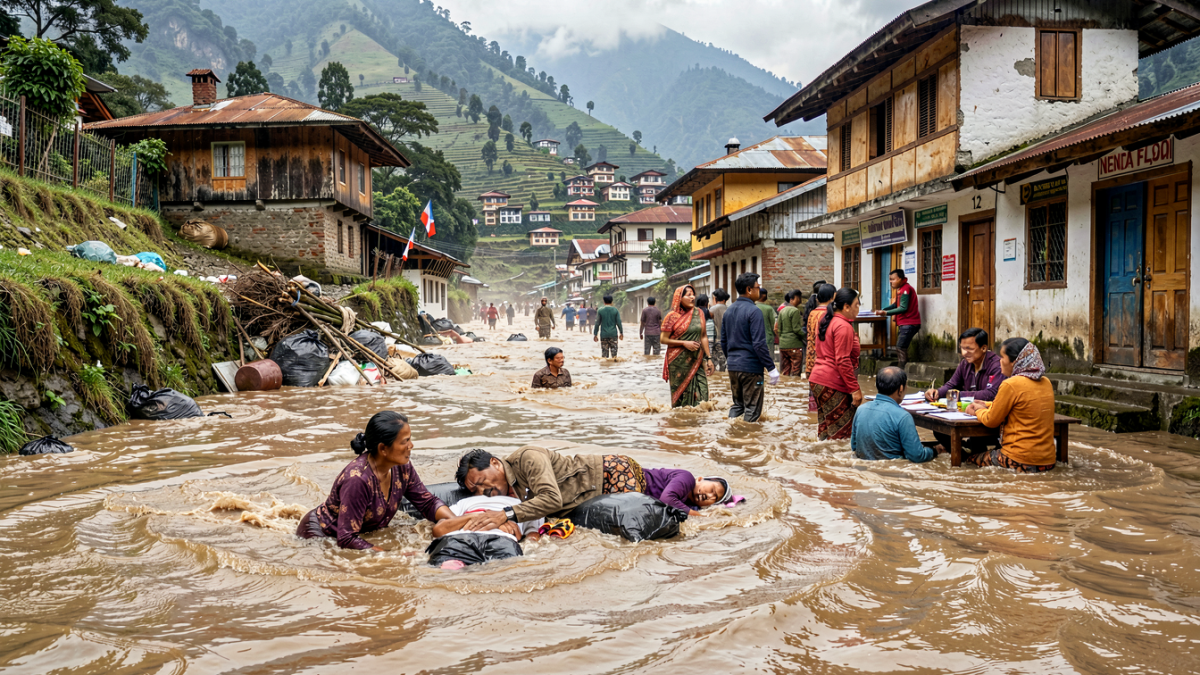
Table of Contents
Nepal’s Bhotekoshi Flood Toll Climbs Past 1,100 as Recovery Efforts Continue
Thebangladaily.com – The Bhotekoshi River, one of the most powerful waterways threading through Nepal’s central hills, unleashed a wall of water and debris last Wednesday morning that has now claimed at least 1,127 lives. Nepal Police confirmed the updated figure in a briefing on Wednesday, marking the deadliest single flash-flood event in the country’s recent history. The catastrophe swept through multiple districts in a matter of hours, dragging massive boulders and sediment downstream into low-lying settlements and leaving communities across the region in shock.
Bodies Recovered Across Eight Districts and Beyond
Recovery teams have pulled victims from a wide geographic spread, reflecting how far the flood’s force carried debris and bodies. The district-by-district breakdown released by police shows the following recoveries:
Chitwan accounted for the largest single share with 348 bodies, followed by Nawalparasi East at 217 and Nawalparasi West at 190. Nuwakot contributed 155, Gorkha 66, Dhading 59, Rasuwa 45, and Tanahun 38. An additional nine bodies were recovered in neighboring India, underscoring how the flood’s reach crossed international boundaries along the river’s lower course.
Of the total, autopsies and associated legal documentation have been completed for 1,113 of the recovered bodies. Ninety-five have already been released to their families for burial or cremation in accordance with local customs. For the remaining 911, police have posted identifying details on their official website so that relatives scattered across Nepal and the diaspora can match descriptions and claim their loved ones.
Rescue Operations and the Missing
A total of 7,912 police personnel have been deployed across the flood-affected zones. Their mandate spans three simultaneous tasks: pulling survivors from trapped positions, distributing food and medical relief to displaced families, and managing the logistics of body recovery and identification. So far, 6,541 people have been extracted from flood-hit areas.
The number still unaccounted for stands at 4,858. Six days after the initial strike, authorities acknowledge that the window for finding survivors alive is narrowing quickly. Debris fields, collapsed embankments, and ongoing water flow make search operations slow and hazardous. Families of the missing are being moved to elevated ground as a precaution against secondary flooding, which remains a realistic threat given the monsoon-season rainfall patterns still in effect across the region.
Why the Bhotekoshi Is So Lethal
The Bhotekoshi (also known as the Tista in its lower reaches) drains a vast catchment in Nepal’s eastern and central Himalayas, collecting glacial melt, monsoon rain, and tributary flows before plunging through narrow gorges into the Terai plains. Its gradient and sediment load make it one of the most energetic rivers in South Asia. When a sudden upstream release—whether from a glacial lake outburst, intense localized rainfall, or a landslide dam failure—hits the lower valley, the resulting flash flood arrives with little warning and carries enough kinetic force to move multi-ton boulders, uproot trees, and flatten structures in its path.
Nepal’s topography compounds the danger. Many settlements sit on narrow floodplains or at the mouths of steep tributary valleys, leaving residents with minutes at most to reach higher ground. Infrastructure such as bridges, culverts, and road embankments, often built to modest engineering standards, can fail catastrophically under flood loads, turning a natural event into a compounded disaster.
Restoring Access and Managing the Aftermath
Local authorities, working alongside police engineering units, are clearing debris from damaged roads and repairing washed-out sections to restore vehicular access to cut-off communities. Until key routes reopen, relief supplies and medical teams must reach affected villages by foot or light aircraft, slowing the pace of aid delivery.
The scale of identification work ahead is enormous. With over 900 bodies still awaiting family claims, police and civil administrators face weeks of paperwork, DNA verification where needed, and coordination with families who may live hundreds of kilometers away. The published online database is intended to reduce that burden, but many rural families lack reliable internet access, meaning door-to-door notification by local officials will remain essential.
As the monsoon season continues, meteorological agencies are monitoring upstream gauges and rainfall accumulations to issue early warnings. Yet the speed at which the Bhotekoshi can transform from a manageable flow to a debris-laden torrent means that even a short lead time may prove insufficient for communities living within the river’s immediate floodplain. Long-term planning—relocation of at-risk settlements, reinforcement of embankments, and investment in real-time hydrological monitoring—will be tested in the months ahead by whatever the next storm season brings.
Related Reading
Frequently Asked Questions
What is Nepal flash flood?
Nepal flash flood is the main topic of this guide. The article explains the context, practical details, and next steps readers should understand.
Why does Nepal flash flood matter?
Nepal flash flood matters because readers are looking for a useful answer, not just a short summary. Good content should match search intent and help them decide what to do next.