US diesel prices hit record high amid Iran war
Gas stations across the United States are posting prices that have never been seen before. The average cost of a gallon of diesel fuel has climbed to $5.85

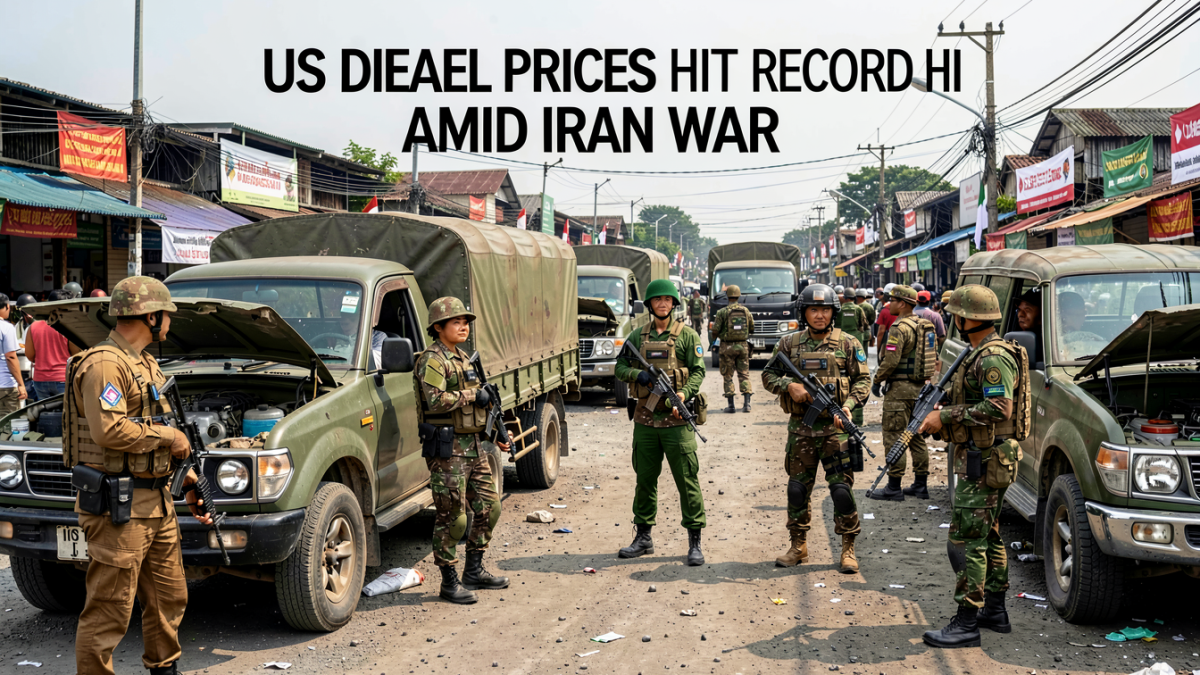
Table of Contents
Record Diesel Costs Grip American Drivers and Industries as Iran Conflict Deepens
Thebangladaily.com – Gas stations across the United States are posting prices that have never been seen before. The average cost of a gallon of diesel fuel has climbed to $5.85, according to the American Automobile Association, shattering the previous benchmark that had been set in the aftermath of Russia’s full-scale invasion of Ukraine. A year ago, at the same point in the calendar, drivers were paying just $3.71 per gallon. The jump of more than $2 in twelve months is not merely a line-item inconvenience; it ripples through every sector that depends on heavy fuel.
Why Diesel Matters More Than Gasoline
Unlike gasoline, which powers most passenger cars, diesel is the lifeblood of the American freight and logistics network. Long-haul trucks hauling produce from California to the East Coast, intercity rail corridors, ocean-going cargo vessels, municipal bus fleets, combine harvesters in the Midwest, and excavators on construction sites all run on diesel. When that fuel becomes dramatically more expensive, the cost does not stay at the pump. It migrates into the price of a pallet of lumber, a shipment of electronics, a ton of grain, and ultimately the grocery bill of ordinary households. The BBC noted that the surge threatens to disrupt not only individual drivers but the entire commercial transport ecosystem.
The Iran War and the Strait of Hormuz
The trigger for the latest spike traces back to late February, when hostilities with Iran escalated sharply. Crude oil is the raw feedstock from which gasoline and diesel are refined, and the global wholesale price of crude began climbing almost immediately. A critical amplifying factor is the effective closure of the Strait of Hormuz, the narrow waterway through which roughly one-fifth of the world’s daily oil supply normally transits. With tankers rerouting or idling, markets have priced in a substantial supply disruption, and that premium flows straight through to retail fuel prices within weeks.
Washington’s Response: A Venezuela Gambit
Facing mounting political pressure from voters watching their fuel bills balloon, President Donald Trump has pledged to “bring down gas prices significantly” for all Americans. The administration’s chosen lever is a sweeping energy agreement with Venezuela, announced on Saturday.
The deal envisions the development of 17 strategic oil fields across the South American nation. Those fields are estimated to hold approximately 65 billion barrels of proven reserves. Venezuelan interim President Delcy Rodríguez framed the projects as capable of drawing in more than $100 billion in foreign investment while generating over $209 billion in tax revenue for the country over their operational lifetimes.
A US official, speaking to CBS News on condition of anonymity, confirmed that Washington would retain a 55 percent controlling stake in the venture, structured as a joint operation with an experienced Venezuelan private-sector partner. The arrangement is designed to give the United States direct operational influence over output levels and export scheduling.
The Maduro Backdrop
The Venezuela initiative does not exist in a political vacuum. Earlier in January, former Venezuelan leader Nicolás Maduro was seized by US special forces, specifically Delta Force, during an operation explicitly authorized by President Trump. His detention reshaped the power structure in Caracas and opened a window for Washington to negotiate terms that previous administrations had been unable to secure. The interim government under Rodríguez now operates under conditions that make a deep energy partnership with the United States both politically expedient and, in some analysts’ views, structurally necessary.
Skepticism and Structural Barriers
Not every observer is convinced the deal will deliver on its promises. Venezuela’s oil sector has endured decades of underinvestment, sanctions, infrastructure decay, and institutional opacity. Several analysts have questioned whether a single joint-venture framework can overcome barriers that have persisted across multiple administrations and geopolitical cycles. The question of whether 65 billion barrels of proven reserves can actually be brought to market at scale, within a timeframe that meaningfully moves US wholesale prices, remains open.
What Comes Next
For the American trucker, the farm operator, and the household watching the pump price tick upward, the near-term answer is not a Venezuelan oil field. It is the Strait of Hormuz, the state of the Iran conflict, and the trajectory of global crude benchmarks. Until those variables stabilize, the record diesel price is likely to remain a feature of the American fuel landscape, and the political pressure on Washington to find a structural fix will continue to build.
Related Reading
Frequently Asked Questions
What is US diesel prices hit record high?
US diesel prices hit record high is the main topic of this guide. The article explains the context, practical details, and next steps readers should understand.
Why does US diesel prices hit record high matter?
US diesel prices hit record high matters because readers are looking for a useful answer, not just a short summary. Good content should match search intent and help them decide what to do next.